


Hair Ice

Updated: Feb 3
 Wonder is a gateway through which the universe floods in and takes up residence within us. –Brian Thomas Swimme and Mary Evelyn Tucker in Journey of the Universe In January, there was a week when the morning temperatures here in the rainforest hovered around 25°F (-4°C), which is cold for us. The rain barely made a showing, snow never fell, the wind was absent, so frost happily hung around, coating as many surfaces as the winter sun would allow.
One early morning, before the neighbor’s roosters crowed and right after a herd of elk grazed through the yard, I bundled up and set out for a walk with our dog Pablo. Our regular walk is up a logging road that follows the north fork of the Trask River, just about ¼ mile from the house. The road goes on for miles and steadily climbs in elevation as it follows the river.
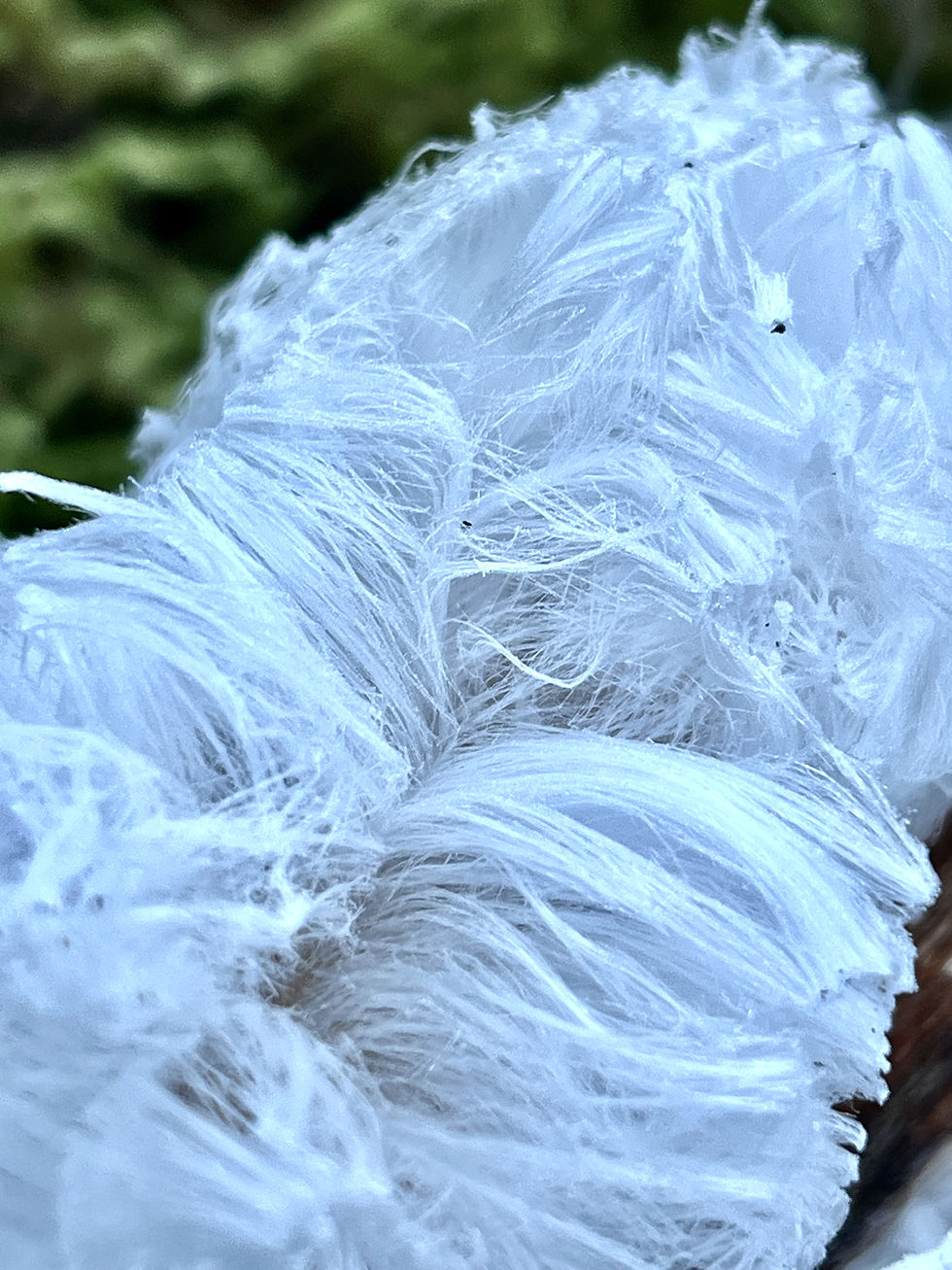
It had been over a month since I’d taken this walk because we’d been in California visiting family and friends for the holidays. A lot had happened in the forest in that month, including atmospheric rivers, high winds, record river levels, and landslides.  The land had a story to tell. I saw where entire trees had toppled, root ball and all, causing other trees to lean or snap from the force then fling broken boughs as if there had been an explosion. The road showed evidence of how swollen creeks dislodged rocks and pushed mud off bare slopes then onto the road and down drainage culverts. What a powerful scene, I thought, and then my eye caught hold of something slightly out of place. I stopped to investigate so I could be nose to nose with the fallen branch from which emerged the most delicate, snow white, fine hair-like designs. Who do we have here? I whispered. Pablo cautiously approached. What I didn’t know then, but do now, is that this phenomenon is called hair ice, sometimes referred to as frost beard, and emerges from the rotting wood of wide leaf trees like the Bigleaf maples growing along the riverbank.  |
Hair ice was first discovered in 1918 by German climatologist Alfred Wegener (1880-1930), best known for his contributions to the understanding of continental drift. “Based on his observation of fungal growths on branches where hair ice formed, he posited but could not confirm that the two were related.”
It’s been over a century and researchers have recently come to understand that “the process is dependent on the actions of a fungi (Exidiopsis effusa) that are tolerant of cold conditions.” Furthermore, “the air temperature needs to be just under 32°F (0°C) and colder than the wood, which cannot be frozen…” and all of it must occur in a sufficiently humid environment, at latitudes between 45 and 55 degrees. (We are just above 45°.) “Under the right…conditions, ice forms on a branch surface while water stays liquid inside the wood’s pores. The temperature difference between the two states of water creates a suction that draws liquid water to the freezing front—gradually extending the reach of the growing ‘hair’. Studies suggest that as the fungus digests part of the wood, it provides fragments of larger molecules that serve as a scaffold on which the ice can grow.” |
 |
And here I want to pause because scientific articles, while informative, can dampen wonder and dismiss the wisdom of these encounters. Mainly, that the connection between tree, fungi, water, and air is a creative relationship that depends on right conditions set into motion by a dynamic 12-billion-year old universe that is home to a 5-billion-year old solar system which eventually made way for a 1-billion-year-old family of fungi and finally, our not too distant ancestors, Homo erectus who emerged in Africa some 1.9-million-years ago.
And if that timeline isn’t gobsmacking enough, all the conditions aligned for me to happen upon and photograph this pop-up art show and eventually share it with you thanks to the web of internet connections, orbiting satellites, and your decision to enter into this space with me. Now you have been introduced to hair ice and who knows what is next for this knowledge we now share!
What if our shared knowledge of hair ice has nothing to do with hair ice, per se, but has everything to do with keeping our senses open to new discoveries that invite a joyful and imaginative trace back along cosmological time? This sort of play encourages us to contemplate the multitude of conditions that have to happen to establish relationships with each other and the more-than-human-world.  |
It is my experience that when times are challenging, it is helpful to step back and take a broader and longer view. A bit of distance and a change in perspective can ease the pain and reveal new understanding. And yet, after meeting hair ice, really moving within an inch of the structures to inspect how each one was so different in their expression, it seems its opposite can be true. A close and meditative focus on a particular detail is its own wise, long view, eventually allowing me to arrive at the realization that, even in the grief of bearing witness to so much suffering in the world, life is a precious gift.
We can begin to appreciate something of the changing nature of the universe when we realize that even our means for sensing the processes of the universe are part of these processes as well. The way we see, the way we hear, the way we feel—each of these senses has been drawn forth and deepened for hundreds of millions of years. We see only because the Earth has long been inventing the sense of sight. And this process is not yet done. –Brian Thomas Swimme and Mary Evelyn Tucker in Journey of the Universe Sources: Earth Magazine - Peculiar Shape of Hair Ice Linked to Fungus by Catherine Hudson Smithsonian Magazine - Here’s How a Strange Phenomenon Called ‘Hair Ice’ Forms on Dead Trees by Maris Fessenden Scientific American - See Strands of Ice That Look like Hair Build up on a Dead Tree Branch by Leslie Nemo Ultimate Mushroom Exidiopsis effusa |


Comments